
Is Indian Real Estate Still Profitable? The ₹1 Crore Flat, Line by Line
RBI data shows Indian house prices rose just 3.6% in Q1 FY27, below the RBI's own 5% inflation forecast. Here is the full five-year maths on a ₹1 crore flat, including stamp duty, brokerage, rent and capital gains tax.
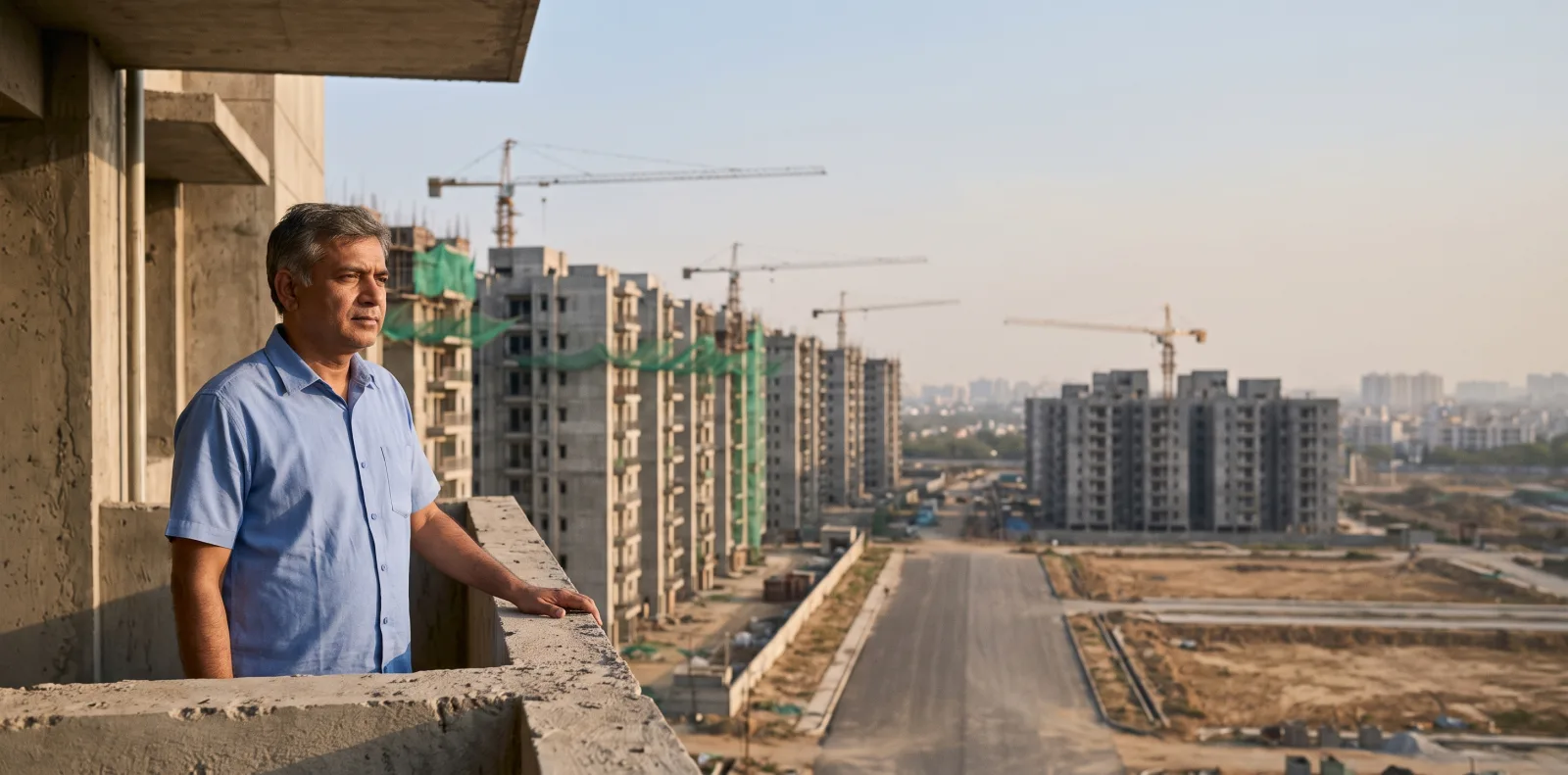
The boom is still on the brochures, not in the data#
Ask a Gurugram sales office and you hear that property never loses. Ask the Reserve Bank of India and you get a number. Its All-India House Price Index for Q1:2026-27, released on 24 August 2026, shows house prices across 18 major cities rose 3.6% over the year, and 1.1% over the previous quarter.
Hold that next to the RBI's own inflation projection of 5.0% for 2026-27. If both hold, the average Indian home is losing purchasing power while its price tag goes up. Not a crash, then. Something slower and easier to miss, and it changes the arithmetic for anyone treating a second flat as a savings plan.
So what does the primary data say about real estate investment in India? Below is the arithmetic on a ₹1 crore flat once you subtract the costs nobody prints in the brochure.
What a house price index is, and why two of them disagree#
A house price index tracks the price of a comparable home over time, the way the CPI tracks a shopping basket. India has three widely quoted ones. They measure different things, which is why they rarely agree.
The RBI's House Price Index is built from transaction-level data supplied by state property registration authorities across 18 cities, with 2022-23 as the base year (index value 100). It captures what buyers actually registered, resales included. In Q1:2026-27 it stood at 117.5.
The National Housing Bank publishes NHB RESIDEX, a 50-city index based on valuation prices collected through lenders. Its most recent composite reading, for the October to December 2025 quarter, rose 5.0% year on year, down from 7.2% a year earlier. The spread underneath that average is enormous: Gurugram up 22.8%, Bengaluru up 12.7%, and Raipur down 8.9%.
A third view comes from private consultancies. ANAROCK's Q1 2026 data puts the average across the top seven cities at ₹9,456 per square foot, up 7% year on year.
Why the gap between 3.6% and 7%? Mostly composition. Consultancy data leans heavily on new launches in seven large cities, and developers have been launching expensive stock: homes above ₹1.5 crore took 53% of Q1 2026 launches. Registration data covers everything, including modest resale flats in Kanpur and Kochi. Interpretation, not fact: if you own an ordinary two-bedroom resale flat, the RBI number probably describes your position better than the headline you read in the property supplement.
Supply has overtaken demand, and inventory is piling up#
The post-pandemic pattern has flipped. Developers are now launching faster than buyers are absorbing.
ANAROCK counted 6,01,200 unsold homes across the top seven cities at the end of Q1 2026, when 1,26,300 new units were launched against 1,01,650 sold. The following quarter, sales fell 6% year on year to 90,715 units while launches rose 7%. Pune dropped 15%, Mumbai 8%.
Inventory overhang, the months needed to clear existing stock at the current sales rate, sat at 18 months nationally: 26 in Hyderabad, 14 in Bengaluru.
Borrowing tells a similar story. RBI sectoral deployment data for July 2026 shows housing credit growing 11.3% against 16.2% for retail credit overall, even though the Monetary Policy Committee left the repo rate at 5.25% at its August 2026 meeting, with a neutral stance. Cheap money is available. Home buyers are borrowing less of it than they borrow for cars.
Affordability explains a good deal of that. Knight Frank's H1 2026 affordability index puts the EMI-to-income ratio at 69% in Mumbai and 67% in NCR, against a 50% threshold beyond which banks rarely underwrite a loan. Ahmedabad sits at 23%, Kolkata 25%, Pune 28%.
The five-year maths on a ₹1 crore flat#
Here is where the brochure and the bank statement part company. Buying costs money before you own anything, and selling costs money again.
Assume a ₹1 crore flat bought outright, no loan. Stamp duty and registration charges vary by state, by city and often by the buyer's gender, typically landing between 5% and 7% of the agreement value. This model assumes 6% plus a ₹30,000 registration fee, roughly the Mumbai case, which comes to ₹6.3 lakh. Brokerage at 1% adds another lakh. You are ₹1.073 crore out of pocket for a ₹1 crore asset.
On exit, hold it beyond 24 months and the gain is long term. Resident individuals pay 12.5% without indexation, or may compute at 20% with indexation if the property was bought before 23 July 2024 and that works out cheaper, per the Income Tax Department. The CBDT explained that change in July 2024. Rent is assumed at a 3.5% gross yield, with 30% lost to maintenance, municipal tax and vacancy, and the remainder taxed at the 30% slab after the standard 30% deduction on house property income.
| Line item | Prices grow 3.6% p.a. | 5.0% p.a. | 7.0% p.a. |
|---|---|---|---|
| Cash paid on purchase | ₹1,07,30,000 | ₹1,07,30,000 | ₹1,07,30,000 |
| Sale price after 5 years | ₹1,19,34,350 | ₹1,27,62,816 | ₹1,40,25,517 |
| Less selling brokerage (1%) | ₹1,19,343 | ₹1,27,628 | ₹1,40,255 |
| Less LTCG tax at 12.5% | ₹1,35,626 | ₹2,38,148 | ₹3,94,408 |
| Plus net rent over 5 years | ₹12,31,939 | ₹12,31,939 | ₹12,31,939 |
| Total value realised | ₹1,29,11,320 | ₹1,36,28,979 | ₹1,47,22,794 |
| Annualised return | 3.77% | 4.90% | 6.53% |
The three columns correspond to the RBI, NHB and ANAROCK growth rates above. Now set them against the two benchmarks the RBI publishes itself: a repo rate of 5.25% and projected inflation of 5.0% for 2026-27. At the pace the RBI's own house price index is running, a debt-free ₹1 crore flat returns less than the rate at which money is losing value. Only the third column clears both benchmarks with room to spare.
Three caveats, and they matter. This is a model, not a forecast; nobody knows which column 2031 will land in. It assumes no home loan, and leverage magnifies gains and losses alike. And a flat you live in is not an investment at all in this sense; it is rent you stop paying.
Rents are improving, and REITs offer property income without the stamp duty#
Rents have been catching up, which is the best news landlords have had in years. ANAROCK's August 2026 study found gross rental yields rose by up to 100 basis points between 2019 and Q2 2026: Bengaluru from 3.6% to 4.6%, Mumbai from 3.5% to 4.3%, Delhi from 2.2% to 3.2%. Over the same period Noida prices rose 125% and Gurugram 117%, against 45% in Kolkata. Location did far more work than the asset class did.
If the appeal is the income rather than the address, REITs in India offer a comparison worth running. A real estate investment trust owns rent-yielding commercial property and is obliged to distribute most of its cash flow to unit holders, who buy and sell units on the exchange like shares. Embassy Office Parks REIT distributed ₹25.28 per unit in FY2026 on net operating income up 15%, and has guided to ₹27.00 to ₹28.60 for FY2027. That is a rising cash distribution from an asset you can sell on a Tuesday afternoon.
You pay no stamp duty, chase no tenant and wait no two years for a buyer. In exchange you give up control over the asset and watch its price move every day, which a flat quietly does too without anyone printing the number.
Key takeaways#
- The RBI's index shows house prices up 3.6% year on year in Q1:2026-27, below the RBI's own 5.0% inflation projection for the year.
- Indices disagree because they measure different baskets. Registration data covers resale across 18 cities; consultancy data leans on new launches in seven.
- Transaction costs are the quiet killer. Roughly 7% goes out on the way in and another 1% plus capital gains tax on the way out.
- Unsold inventory across the top seven cities stood at 6,01,200 units with an 18-month overhang, and sales fell 6% year on year in Q2 2026.
- Rental yields have improved by up to 100 basis points since 2019, and listed REITs give exposure to rent-yielding property without stamp duty or illiquidity.
Frequently asked questions#
Is property still a good investment in India? It depends on the city, the price paid and the holding period. National averages hide a market where Gurugram rose 22.8% while Raipur fell 8.9% in the same quarter. This article is information, not investment advice.
How much tax do I pay when I sell a flat? If held more than 24 months, long-term capital gains are taxed at 12.5% without indexation. Resident individuals may instead compute at 20% with indexation if the property was acquired before 23 July 2024 and that produces a lower bill.
What is a good rental yield in India? ANAROCK's 2026 figures put the top cities between 3.2% and 4.6% gross, before maintenance, property tax and vacancy. Net yields are meaningfully lower.
Why does my builder claim 12% appreciation when the RBI says 3.6%? Builders quote micro-market or new-launch prices, often over a longer window. The RBI figure is a citywide annual average from registration records. Both can be accurate about different things.
Are REITs safer than owning a flat? Not safer, differently risky. They are liquid and professionally managed, but unit prices move daily and distributions are not guaranteed.
Does the new Income-tax Act change property taxation? The Income-tax Act, 2025 took effect on 1 April 2026 and renumbers most provisions, but the capital gains rates and 24-month holding period carried over.
Should I buy now or wait? Nobody can answer that for you. The data does show supply exceeding demand across the top seven cities, which historically strengthens the buyer's hand in a negotiation.
Glossary#
House Price Index (HPI): A number tracking the price of a comparable home over time against a base year set at 100.
Inventory overhang: How many months it would take to sell all unsold homes at the current sales pace.
Gross rental yield: Annual rent divided by property value, before maintenance, tax and vacancy.
Indexation: Adjusting a purchase price upward for inflation before computing capital gains, which reduces taxable gain.
Long-term capital gains (LTCG): Profit on an asset held beyond the statutory period, 24 months for immovable property, taxed at a concessional rate.
REIT: A listed trust that owns rent-yielding property and distributes most of its cash flow to unit holders.
EMI-to-income ratio: The share of household income going to the loan instalment; lenders rarely approve above 50%.
Basis point: One hundredth of a percentage point. A rise from 3.6% to 4.6% is 100 basis points.
References#
- Reserve Bank of India, All-India House Price Index for Q1:2026-27, 24 August 2026.
- Reserve Bank of India, Monetary Policy Statement, 5 August 2026.
- National Housing Bank, NHB RESIDEX press release, quarter ended December 2025.
- ANAROCK, Pan-India Residential Market Viewpoints, Q1 2026.
- Business Standard, Housing sales down 6% in Apr-Jun in top 7 cities, avg price up 7%: Anarock, 29 June 2026.
- Business Today, Top housing markets deliver up to 125% price appreciation, rental yields rise by 100 bps: ANAROCK, 4 August 2026.
- Business Standard, Ahmedabad tops affordability chart; MMR, NCR stay beyond 50% EMI threshold, 3 July 2026, reporting Knight Frank India's Affordability Index H1 2026.
- Business Standard, Industry credit growth accelerates to 20% in July; gold loans moderate, 31 August 2026, reporting RBI sectoral deployment data.
- Income Tax Department, Government of India, Tax on long-term capital gains.
- Press Information Bureau, FAQs issued by CBDT on the new capital gains tax regime, 24 July 2024.
- Embassy Office Parks REIT, FY2026 results press release, 27 April 2026.