Personal Finance and Commodities
18K Gold Searches Just Overtook 22K. Here's What Buyers Are Doing
Searches for 18K and 20K gold rates in India have climbed far faster than searches for 22K. The numbers behind the shift, and the making-charge trap that can cancel out the saving.
A price check that says more than the price#
Something odd turned up in India's search data this July. For the first time in the twelve months of records, the query 18k gold rate today was typed more often than 22k gold rate today: according to Google search volume data.
For a country that has treated 22-carat as the default setting for gold jewellery for generations, that is not a small reversal. The 916 stamp is practically shorthand for gold in Indian households. Yet the number people are now checking before they walk into a showroom increasingly ends in 750.
The obvious explanation is price, and price is most of it. With 24-carat gold at ₹15,430 a gram on 10 September 2026, a budget that once bought a decent chain now buys a thin one. But the search data says something more specific than "gold is expensive". It says buyers are shopping for a different product, and that the trade has already rearranged itself to sell it to them.
Whether that arrangement leaves the buyer better off is a separate question, and the arithmetic below is less flattering than the price tag suggests.
What a karat actually measures#
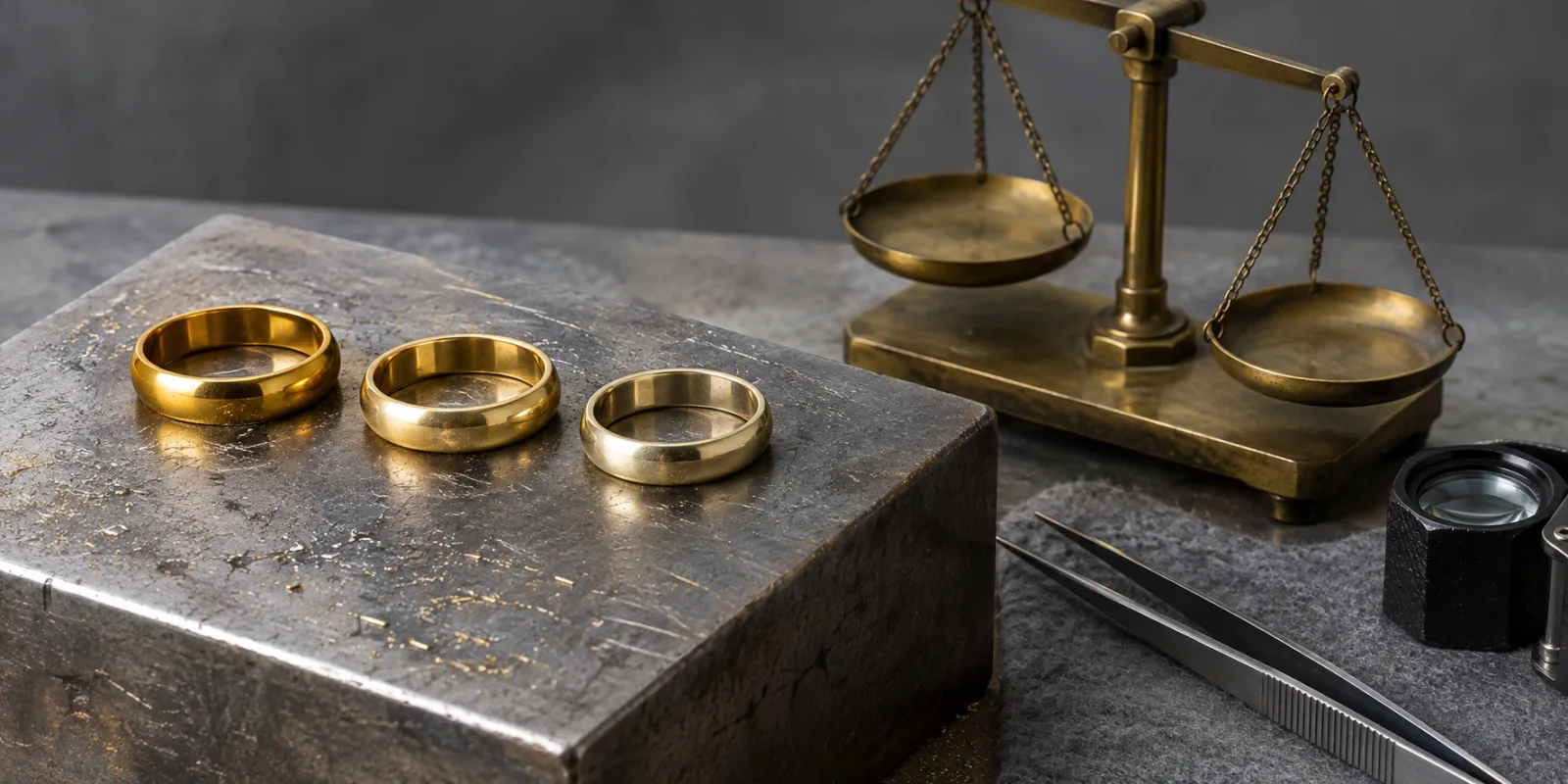
A karat is a fraction with 24 on the bottom. Pure gold is 24 karats, meaning 24 parts out of 24. Everything below that is gold mixed with other metals, usually copper, silver, zinc or nickel, to make it harder and cheaper.
So 22-carat gold is 22 parts gold in 24, or 91.6% pure, which is where the familiar 916 stamp comes from. 18-carat is 18 parts in 24, or 75% pure, and gets stamped 750. Twenty-carat is 83.3%, stamped 833. The stamped number is called fineness: parts of gold per thousand.
India's Bureau of Indian Standards fixes which grades may legally carry a hallmark. Under IS 1417, the BIS hallmarking scheme covers 14K (585), 18K (750), 20K (833), 22K (916), 23K (958) and 24K (995). A hallmark carries three marks: the BIS logo, the purity in caratage and fineness, and a six-digit alphanumeric HUID number unique to that item.
In July 2025 the list got longer. The consumer affairs ministry approved hallmarking for 9-carat gold, at a minimum fineness of 375, which is jewellery that is 37.5% gold and nearly two-thirds something else. India Bullion and Jewellers Association secretary Surendra Mehta said the move would "spur demand, especially in rural areas". Senco Gold's Suvankar Sen called it "a great initiative to make gold jewellery more accessible amid high prices".
Two things follow. Indian buyers now have seven hallmarked purity grades to choose between instead of three. And the regulator has formally blessed the direction the market was already heading.
What the search numbers show, and what they don't#
Here is the year-on-year movement in Indian search volume for the main karat queries, comparing August 2025 with July 2026.
| Search query (India) | Aug 2025 | Jul 2026 | Change |
|---|---|---|---|
| 18k gold jewellery | 1,900 | 9,900 | +421% |
| 18k gold rate today | 60,500 | 110,000 | +82% |
| 20k gold rate today | 3,600 | 5,400 | +50% |
| 20 carat gold rate today | 9,900 | 14,800 | +49% |
| 22k gold rate today | 49,500 | 74,000 | +49% |
| 18 carat gold price today | 301,000 | 368,000 | +22% |
| 14k gold rate today | 8,100 | 9,900 | +22% |
| 916 gold rate today | 110,000 | 110,000 | 0% |
Source: Google Ads monthly search volume for India, retrieved 10 September 2026 via the DataForSEO.
The honest reading of that table is more interesting than the headline, and it is not simply that 18K is winning.
One qualification first. Indians phrase these searches several ways, so no single pair settles the question. Add the two commonest phrasings together and 18K still leads comfortably, at about 478,000 monthly searches in July 2026 against roughly 184,000 for the 22K equivalents, but the margin depends on which phrasings you count.
Every gold query rose, because the gold price rose and worried people go and look. That much is noise. What matters is the gaps between the rows. Price-checking for 18K grew at roughly two-thirds again the rate of price-checking for 22K, while 916 gold rate today, the most traditional phrasing there is, did not grow at all. Meanwhile 18k gold jewellery, which is a shopping query rather than a price query, went up more than fivefold off a small base.
One more caveat. These volumes peaked in January to March 2026, when 18 carat gold price today hit 823,000 in a single month, and have since fallen back. The surge is not still accelerating. It has settled onto a plateau roughly a fifth to four-fifths higher than a year ago, depending on the query. What that looks like is a habit forming rather than a panic still under way.
The odd entry is 20-carat. Roughly 20,000 Indians a month look up a rate for a grade that is perfectly legal to hallmark but that few showrooms stock in any quantity. My reading, and this is interpretation rather than established fact, is that 833 is what people reach for when 22K feels unaffordable and 18K feels like a compromise too far.
The arithmetic in the showroom#
At Mumbai rates on 10 September 2026, 22-carat gold cost ₹14,144 a gram and 18-carat ₹11,572. That makes 18K about 18% cheaper per gram of finished jewellery.
Cast as a purchase, a 20-gram chain in 22K carries ₹2,82,880 of metal. The same chain in 18K carries ₹2,31,440. Fifty thousand rupees, before anyone has discussed design.
Now flip it round, which is how buyers actually think. Take a fixed budget of ₹1,00,000 for a plain piece and add the two costs that always follow: making charges, and 3% GST on the gold. Nagpur retail data compiled on 10 September 2026 puts plain 22K making charges at 8 to 12% and plain 18K at 10 to 15%. The source explains the higher 18K figure by noting that "diamond setting work (used in 18K pieces) requires more precision and time".
Take the midpoints, 10% on 22K and 12.5% on 18K. The 22K route works out at ₹16,025 an effective gram, so ₹1,00,000 buys 6.24 grams of jewellery holding 5.72 grams of pure gold. The 18K route works out at ₹13,409 a gram, so the same money buys 7.46 grams of jewellery holding 5.59 grams of pure gold.
Nineteen per cent more jewellery, and about two per cent less gold.
The 18K piece is visibly bigger and sits better on the neck, which is exactly what a buyer with a fixed budget wants, but the extra bulk is alloy and the higher labour percentage quietly eats the purity saving. Shift the making-charge assumptions and the answer shifts with them. Negotiate 18K down to 10% and you come out modestly ahead on gold content, which is the whole point: it is the making-charge line, not the karat line, that decides this.
Two caveats on my figures. They assume plain work and identical making-charge treatment, and studded 18K pieces behave differently because the stones carry their own valuation. GST is also charged at 3% on the gold and 5% on making charges, which I have simplified to a flat 3% for readability.
The trade moved first#
None of this is a secret inside the industry. The behaviour showed up in official demand data well before it showed up in search.
The World Gold Council's India figures for the second quarter of 2026 record jewellery demand of 75 tonnes, down 15% year-on-year, while spending on that jewellery hit ₹1,132 billion, up 34%. Fewer grams, more money. The Council attributes it to "the shift towards lighter-weight, lower-carat and studded jewellery", with the average MCX gold price at ₹1,50,733 per 10 grams, 59% higher than a year earlier.
The first quarter told the same story: jewellery tonnage down 19%, value up 47%, and jewellery's share of total Indian gold demand falling to 30%, the lowest since 2000.
Retailers responded by rebuilding the shelf. A Business Standard survey of jewellery majors on 6 September 2026 found them recalibrating offerings "to include more 9-carat, 14-carat, and 18-carat options", with gold-exchange schemes now accounting for around half of sales. Titan's CaratLane launched 9-carat jewellery outright, betting that younger buyers want adornment rather than a store of value.
Malabar Gold and Diamonds' India managing director O Asher described the mechanics plainly as far back as May 2025: "In some regions, we have observed customers transitioning from 22-carat to 18-carat jewellery." His explanation was not about taste. "If someone has a budget of one lakh rupees, they cannot increase it, so we've adapted our strategy."
A seller describing his own customers put it better than any demand statistic can. The budget stays where it is, the price does not, and what gives way is purity.
What 18K costs you on the way out#
Buying is half the transaction. Indian households sell and exchange gold constantly, and the WGC reports old-gold exchange accounting for 40% to 60% of transactions in early 2026, rising to as much as 70% at some retailers in Q2.
The resale formula is mechanical: grams × current 24K rate × purity fraction. For 18K that fraction is 0.75. As CaratLane's own guidance states, making charges and GST are not recovered on resale, "similar to what happens with 22k jewellery".
That last clause matters, and it cuts in 18K's favour. Proportionally, 18K is not a worse deal on exit than 22K, because you paid about 82% of the 22K per-gram price and you get back about 82% of the value. The purity is priced in at both ends.
Where 18K loses is liquidity and habit. Not every neighbourhood jeweller, pawnbroker or gold-loan counter is equally comfortable valuing 750 material, and the further you get from 916 the fewer buyers know what they are looking at. Twenty-carat is worse on this count than 18K. Nine-carat, at 62.5% base metal, is likely to be worse still, though the grade is too new in India for anyone to have reliable resale evidence yet.
Whichever grade you choose, a few checks are worth the trouble. Confirm the hallmark carries all three marks, including the HUID, and verify it on the BIS Care app. Get the purity written on the invoice as both caratage and fineness. Then ask the buyback terms before you pay rather than after, and specifically whether the jeweller pays the full prevailing rate on fine gold content or applies a deduction.
Key takeaways#
- In July 2026 Indians searched 18k gold rate today 110,000 times against 74,000 for 22k gold rate today, and 18K rate queries grew 82% year-on-year against 49% for 22K.
- The clearest signal is commercial rather than curious: 18k gold jewellery, a shopping query, rose from 1,900 to 9,900 monthly searches, while 916 gold rate today was flat.
- BIS now permits hallmarking at seven purity grades, after 9-carat gold at 375 fineness was approved from July 2025.
- On a fixed ₹1,00,000 budget with plain making charges at 10% for 22K and 12.5% for 18K, the 18K route buys roughly 19% more jewellery by weight but about 2% less pure gold. The making-charge line, not the karat line, decides whether the switch pays.
- World Gold Council data confirms the behaviour rather than merely the interest: Indian jewellery demand fell 15% by weight in Q2 2026 while spending rose 34%.
Frequently asked questions#
Is 18-carat gold real gold? Yes. It is 75% gold by weight, alloyed with other metals for hardness and colour. It qualifies for a BIS hallmark and carries the fineness mark 750.
Is 18K a worse investment than 22K? Neither is an efficient investment, because making charges and GST are unrecoverable on both. Judged purely as metal, 18K is priced proportionally to its gold content at purchase and at resale, so it is not inherently worse. It is simply less gold per gram.
Why is 18K jewellery so common for diamond pieces? Lower gold content means a harder alloy, which holds stone settings more securely. This is why studded jewellery is usually 18K even where the buyer could afford 22K.
Can I get 20-carat gold hallmarked? Yes. 20K at 833 fineness is one of the grades specified under IS 1417. Availability at retail is a separate matter from legality.
Should I buy 9-carat gold? That depends entirely on whether you are buying ornament or value. At 37.5% gold it is the cheapest hallmarked entry point in India, but it is new to the market and its resale behaviour here is untested. This is general information, not advice.
How do I check a hallmark is genuine? Look for all three components (BIS logo, purity in caratage and fineness, and the six-digit HUID), then verify the HUID through the BIS Care mobile app before leaving the shop.
Does lower carat mean lower making charges? Usually the opposite in percentage terms. Retail data puts plain 18K making charges above plain 22K, partly because 18K pieces more often involve stone setting.
Glossary#
Karat (carat). A measure of gold purity expressed in twenty-fourths. 24K is pure gold; 18K is 18 parts gold in 24, or 75%.
Fineness. Parts of gold per thousand. 916 means 91.6% gold, 750 means 75%, 833 means 83.3%, 375 means 37.5%.
Hallmark. The BIS mark certifying purity, comprising the BIS logo, the caratage and fineness, and a unique HUID number.
HUID. Hallmark Unique Identification, a six-digit alphanumeric code unique to each hallmarked article and traceable through BIS systems.
Making charges. The jeweller's labour and design fee, levied either per gram or as a percentage of gold value, and not recoverable when you sell.
Wastage charges. An allowance for metal lost in crafting, typically 5% to 7% of gold weight and higher on complex handmade work.
Alloy. The non-gold metals, commonly copper, silver, zinc or nickel, mixed with gold to control hardness, colour and cost.
Old-gold exchange. Trading in existing jewellery against a new purchase, valued on fine gold content at the prevailing rate.
A note on scope#
This piece reports search volume data, published gold rates, official BIS provisions and industry demand figures as of 10 September 2026. Search volumes are estimates from Google Ads and are rounded by the source. Gold rates, making charges and buyback terms vary by city, jeweller and day. The worked example is a calculation based on the stated assumptions, not a quotation from any retailer. This is general information and not investment advice.
References#
- Bureau of Indian Standards, Hallmarking FAQs: caratage grades under IS 1417 and HUID composition
- Bureau of Indian Standards, Hallmarking: information for jewellers
- World Gold Council, Gold Demand Trends: India Focus Q2 2026
- World Gold Council, Gold Demand Trends: India Focus Q1 2026
- Business Standard, Hallmarking for 9 carat gold gets green light: what it means for consumers, 21 July 2025
- Indian Jeweller, India extends mandatory hallmarking to include 9-carat gold
- Business Standard, Jewellery retailers, gold costs, exchange and lower price points, 6 September 2026
- The Tribune, Customers shifting to 18-carat jewellery from 22-carat as gold rates rise, says Malabar Gold, 28 May 2025
- MarketScreener, Titan's CaratLane eyes growth as young Indians embrace low-carat jewellery
- The Sunday Guardian, Gold price today, 10 September 2026: 24K, 22K and 18K rates per gram, city-wise
- Londe Jewellers, Gold making charges, 22K and 18K, data dated 10 September 2026
- CaratLane, Does 18K gold have resale value: India price and buyback guide
- DataForSEO, Google Ads monthly search volume for India, retrieved 10 September 2026