Tata Sons Chairman Chandrasekaran Resigns: What Comes Next for India's Biggest Empire
N Chandrasekaran resigns as Tata Sons chairman six months after a board deadlock over his reappointment. We unpack the governance shock, the market reaction, and what investors should watch.
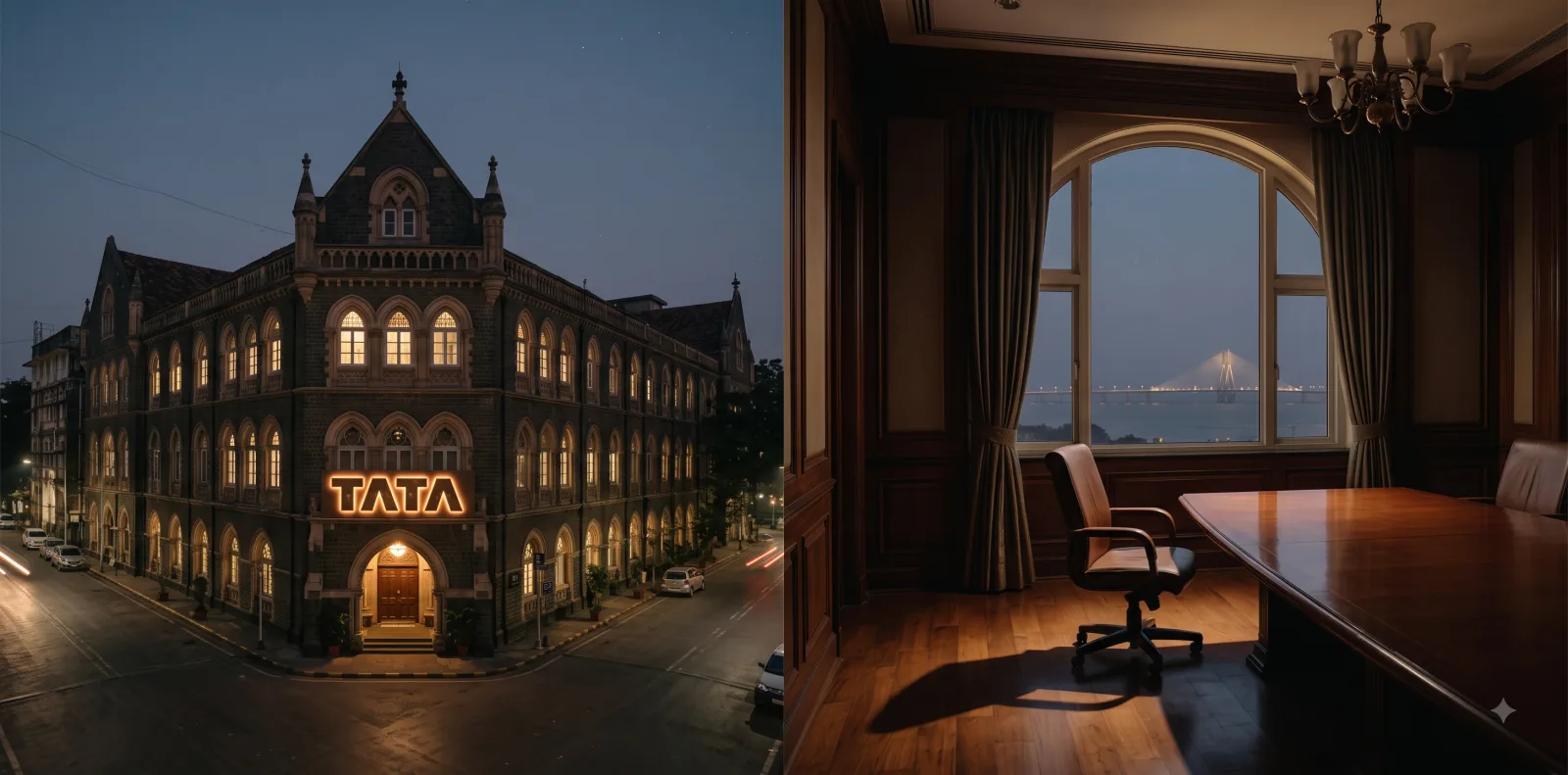
A 63-year-old engineer from Tamil Nadu who once ran the world's most valuable IT services company has told the board of India's largest conglomerate that he will not fight for his job. N Chandrasekaran's resignation on Wednesday as chairman of Tata Sons, six months after a boardroom standoff left his reappointment in limbo, has put a $185 billion-revenue, $277 billion market-cap industrial empire in the middle of its most delicate transition in nearly a decade. Dalal Street's reaction was swift and unkind: the Tata group index fell 1.7%, TCS dropped as much as 4.84% intraday, and Tata Motors Passenger Vehicles slid up to 4% within minutes.
What Happened?#
On the morning of 12 August 2026, Chandrasekaran wrote to the Tata Sons board saying he would not stand for reappointment when his current tenure ends on 20 February 2027, and would stay on until then to oversee an orderly handover (Times of India; Business Today).
The trigger was a 24 February 2026 board meeting at which his five-year extension was tabled but failed, because "one of the Board Members did not support it." With no unanimous backing, the chairman chose to defer, and six months on, the stalemate had not moved (Reuters).
That lone dissent is widely identified as Noel Tata, half-brother of the late Ratan Tata and chairman of the Tata Trusts. His reservations centre on cumulative losses at Air India, Tata Digital and Tata Play, and on a long-running disagreement over whether to list Tata Sons itself (Business Standard; Reuters).
The resignation lands six days before Tata Sons' 108th AGM, already clouded by a separate flashpoint. The Maharashtra Charity Commissioner has frozen meetings of the Sir Ratan Tata Trust (SRTT), one of the two trusts that must jointly nominate a representative to form a valid quorum under Article 86 (Business Standard; Outlook Business). Without a quorum, dividends and the AGM's legitimacy could be in question.
Reading the Tata Group's Architecture#
A few structural facts explain why a chairman's resignation moves equity prices from Mumbai to London.
Tata Sons is the principal holding company. It controls 26 listed entities, including TCS, Tata Motors, Titan, Tata Steel, Tata Power, Indian Hotels, Trent, Tata Consumer and Tata Elxsi, with a combined market capitalisation of about $277 billion as of 31 March 2026, per the Tata Sons Annual Report FY26. FY26 group revenue was ₹16.24 lakh crore (around $185 billion) and profit after tax ₹1.71 lakh crore (CNBC TV18).
Tata Sons is itself owned, about 66%, by charitable trusts, the most important being the Sir Dorabji Tata Trust (SDTT) and the Sir Ratan Tata Trust (SRTT). The Tata family holds no operating equity. Control sits with the trust mechanism and the holding-company board, not with the family.
The Tata Sons chairman is also a steward of the trusts' charitable mandate, chair of the holding-company board that appoints leadership across every listed Tata entity, and the public face of a group that employs more than a million people.
The 2016–17 transition is the precedent that explains today's anxiety. When Cyrus Mistry was removed in October 2016, the move triggered protracted legal battles and exposed the absence of a formal succession protocol.
Market Implications#
The 12 August sell-off was the most concentrated Tata-group drawdown in months, even though the operating businesses at TCS, Titan and Tata Motors were unchanged.
TCS, in which Tata Sons holds a 71.74% promoter stake, fell 4.84% intraday to ₹2,322, extending a 27.26% year-to-date decline ([Business Today]). Tata Consumer Products lost 1.6%, Titan 1.3%, Tata Power 1.09% and Tata Steel 1.03%. The Nifty 50 slipped 157 points to 24,314, with the resignation cited as one of three "key reasons" for the broader weakness.
Three transmission channels matter for the rest of the market. First, index weight: TCS has the heaviest weight in the Nifty IT, so a 5% move mechanically drags the index. Second, the holding-company discount widens during governance uncertainty, and sell-side desks will revisit SOTP numbers. Third, cross-asset spillover was modest: the rupee and the India 10-year did not move sharply, but the news coincided with rising crude and a separate 10% slide in Godrej Consumer on its own CEO exit.
In the medium term, two binary events will decide the trajectory: the 18 August AGM, and the identity of Chandrasekaran's successor.
The Mechanics of a Holding-Company Succession#
Quorum arithmetic. Under Article 86, a valid general meeting of Tata Sons requires a representative jointly nominated by the SDTT and the SRTT, provided the two trusts together hold at least 40% of the equity. Their combined holding of roughly 66% is well above the threshold, but the mechanism breaks if the two trusts cannot agree on a joint nominee. With SRTT unable to hold trustee meetings under the Charity Commissioner's directions, the joint-nomination requirement is functionally unachievable without regulatory intervention (Times Now).
Director reappointment cascade. The chairman of Tata Sons is also a director of the holding company. Under the Companies Act, 2013, his reappointment is voted on at the AGM, and if it fails, his chairmanship ends abruptly. Chandrasekaran has pre-empted that cliff, but the cascade risk remains for any internally promoted successor.
SOTP and the holding-company discount. Listed Tata companies are valued in two layers: an operating-business SOTP using peer multiples, and an implicit holding-company premium or discount derived from parent-level capital allocation. With TCS's payout to Tata Sons now at its lowest in the post-Covid period, the discount has begun to reassert itself, and a leadership vacuum is likely to widen it until succession clarity emerges.
For minority shareholders, the trust-controlled structure means there is no formal say in who chairs the holding company. The right framework for an allocator is a "trust-control overlay", treating the group as a quasi-state actor and pricing a small but persistent governance discount during transition windows.
Critical Analysis#
On balance, Chandrasekaran's decision is a stabilising one. By announcing now and serving out his term, he avoids a contested AGM and a court challenge, the route that consumed the group between 2016 and 2019, and gives the Trusts space to negotiate a successor without hostage-taking risk.
The six-month stalemate, however, has already cost time. Several large strategic projects, including Air India's restructuring, the Sanand semiconductor fab, the HyperVault AI data-centre venture with TPG, and the Panapakkam passenger-vehicle ramp-up, require board-level decisions that have been effectively frozen since February (Tata Group FY26 Annual Report). A six-month runway to February 2027 is tight for a group of this complexity, and there is no obvious internal successor with Chandrasekaran's combination of operating credibility and trust-level political capital.
Some analysts argue the news is already in the price. Ambareesh Baliga, an independent market analyst, told Business Standard the fall is "temporary", and counters will bounce back once a successor is named (Business Standard). U R Bhat of Alphaniti Fintech was more cautious, calling the transition "not going to be smooth." Both can be right: a near-term bounce on relief, then a discount widening if the successor is contested.
An under-discussed risk is regulatory. If the Charity Commissioner does not lift the SRTT freeze before the 18 August AGM, Tata Sons may technically be unable to hold a valid meeting, complicating dividends to every Tata entity that depends on Tata Sons' own dividend, including the Trusts themselves. The cascade could reach Indian Hotels' expansion budget and Tata Power's renewable build-out, which draw on internal cash from Tata Sons.
Historical Context#
Tata Sons has had only three chairmen in three decades: Ratan Tata, Cyrus Mistry, Chandrasekaran, and the brief interim arrangements around 2016. Each transition has been punctuated, not smooth.
The 2016 Mistry removal was litigated for years, and the National Company Law Appellate Tribunal's 2019 ruling restoring Mistry was itself contested. The trauma still shapes how Indian institutional investors price conglomerate risk (Bloomberg).
Chandrasekaran's 2017 appointment was meant to be a clean break: a career Tata technocrat with no family connection, and a more professional model of succession. Wednesday's resignation is a verdict on how fully that promise was kept. The friction now sits inside the trust-controlled structure that was supposed to depoliticise the group, not with an external shareholder like the Shapoorji Pallonji group.
Whether the next transition is incremental, structural or paradigmatic will depend on whether the Trusts rewrite Article 86 before February 2027, and whether the successor is a Tata insider or an external candidate.
Key Takeaways#
- Tata Sons is in a six-month controlled transition. Chandrasekaran serves until 20 February 2027; the board has been asked to name a successor.
- The trigger was an unresolved February 2026 board vote in which a single dissent, widely reported to be Noel Tata, blocked a five-year extension.
- The market's verdict on the day was unambiguous: TCS down nearly 5%, the Tata group index down 1.7%, though analysts expect a relief bounce once succession clarity emerges.
- The 18 August AGM is a separate governance flashpoint: the Charity Commissioner's freeze on SRTT may prevent the joint quorum required under Article 86.
- Strategic projects at Air India, semiconductors, batteries and AI infrastructure now run on a shorter decision-making runway, raising the cost of any further delay.
Frequently Asked Questions#
Why is the chairman of Tata Sons so important? Because Tata Sons controls 26 listed companies with a combined market cap of about $277 billion, and the chairman sits on the boards of most of them. Leadership change at the holding company is felt across the entire group.
Who are the leading candidates to succeed Chandrasekaran? No successor has been named. Names floated in past succession cycles include Noel Tata, current TCS CEO K Krithivasan and other internal candidates, but no shortlist has been disclosed.
Will this affect TCS's day-to-day business? No. TCS's Q1 FY27 results, announced 17 July 2026, showed 12% YoY revenue growth in the standalone business. The market reaction is about governance, not operations.
What happens at the 18 August AGM? The AGM is meant to approve annual accounts, declare dividends and vote on director appointments. With SRTT unable to hold meetings, it is unclear whether a valid quorum can be formed.
Is this a Tata Trusts versus operating-board conflict? It appears so. The Trusts' 66% holding gives them formal control, but the February 2026 board vote shows the holding-company board can block a candidate even when the Trusts are split.
How does this compare to the 2016 Cyrus Mistry episode? The structural issue is similar (trust-controlled succession), but there is no contested court battle, and the operating businesses are in far better shape.
What should an equity investor watch next? Any Tata Sons board statement on succession, the Charity Commissioner's decision on SRTT, and the AGM outcome on 18 August.
References#
- Tata Sons Annual Report FY26 — tata.com
- "Chair of India's Tata Sons may step down ahead of shareholder meeting" — Reuters
- "India's Tata group needs a new leader" — Reuters Breakingviews
- "Tata Sons Chairman Resigns in Shock Move Ahead of AGM Next Week" — Bloomberg
- "Ahead of Tata Sons AGM, N Chandrasekaran resigns as chairman" — Business Today
- Full text of Chandrasekaran's statement — Times of India
- "Tata Sons Chairman N Chandrasekaran resigns, to complete term till February" — India Today
- "Tata Sons calls AGM on August 18 amid uncertainty over lack of quorum" — Business Standard
- "Why Tata Sons' August AGM Could Run Into A Quorum Problem" — Outlook Business
- "Tata group stocks fall up to 4% as Chandrasekaran resigns" — Business Standard
- "Tata Group stocks may shrug off Chandra's exit in the long run: Analysts" — Business Standard
- "TCS, Tata Motors And Other Group Stocks Fall Up To 5%" — Outlook Money
- "Tata Sons' Chairman N Chandrasekaran resigns" — Upstox
- "Tata Sons Chairman Resigns" — Daily Pioneer
- "TCS, Tata Motors, TCPL, Titan, Tata Power, Tata Steel shares hit hard" — Business Today
- "Tata Sons AGM In Limbo: Tata Trusts To Meet On August 13" — Outlook Business
- "Tata Sons To Hold AGM On August 18" — Times Now
- "'Chips are the new steel,' says Tata Sons Chair as FY26 profit climbs" — CNBC TV18
- "Tata group profit jumps 5x in six years as market value triples" — Economic Times
- "Tata group stocks fall up to 4% as N Chandrasekaran steps down" — Times of India
- "Sensex Today | Stock Market LIVE Updates" — Economic Times
- Wikipedia: "Tata Group" — en.wikipedia.org
- "TCS payout to Tata Sons falls most since Covid" — Moneycontrol