India's Closing Auction Reboots the Trading Day
SEBI's Closing Auction Session, live since 3 August 2026, replaces the VWAP close for F&O stocks with a single-price auction. Here is how it works, why it matters, and what its chaotic first week reveals.
Every trading day this week, at 3:30 in the afternoon, the price that anchors roughly $5 trillion of Indian equity value has been set in a way it never was before. Since Monday 3 August 2026, the closing price of every stock with listed futures and options is no longer a volume-weighted average of the final half hour. It is the output of a single, sealed auction. This is the most consequential change to Indian market microstructure in years, and its early days have been anything but smooth. For anyone who trades, indexes, hedges or settles against the Indian close, the mechanics of the last twenty minutes have quietly become the most important part of the day.
What happened#
The Securities and Exchange Board of India (SEBI) has introduced a Closing Auction Session (CAS) for all derivatives-eligible stocks, replacing the previous method in which the official close was the volume-weighted average price (VWAP) of trades in the final thirty minutes of continuous trading. The reform, mandated by a SEBI circular dated 16 January 2026, went live across the National Stock Exchange (NSE), BSE and the Metropolitan Stock Exchange on 3 August 2026 (Share.Market; Paytm Money).
In Phase I, the cash market is split into two categories. Category I comprises stocks that have active futures and options contracts (this includes every Nifty 50 and Bank Nifty constituent), and only these names pass through the auction. All other stocks continue to close exactly as before (NSE).
The session runs from 3:15 pm to 3:35 pm. The first five minutes, from 3:15 to 3:20, are a transition and calculation window in which no fresh orders are accepted; order entry then reopens from 3:20 to 3:30 (Outlook Money). Only limit and market orders are permitted during the auction; stop-loss and iceberg orders are excluded, and any resting stop-loss orders on eligible stocks are cancelled rather than carried in (Sahi).
Background: what a closing auction actually is#
A closing auction is a call auction held once at the end of the day. Rather than matching orders continuously as they arrive, the exchange collects all buy and sell interest into a single book and then computes one equilibrium price: the price at which the largest possible quantity of shares can change hands. If two prices would match the same maximum volume, the exchange chooses the one with the smallest imbalance between buy and sell quantity; if still tied, the price closest to a reference level (Paytm Money). Crucially, everyone who trades in the auction is filled at that single price, regardless of the limit they entered. This is a different market than the one operating a minute earlier.
The reference price provides an anchor. Under the Indian design it is the VWAP of trades executed between 3:00 and 3:15 pm, and orders during the auction are confined to a price band of plus or minus 3% around it (Sahi). If no orders match in the window, the reference price itself becomes the official close.
The third idea is VWAP itself: the average price weighted by volume over a period. India's old close was a VWAP of the last thirty minutes. That is easy to compute but has a subtle flaw: it is an average of a moving market, not a price anyone can actually transact at in size. An institution needing to buy a large block at the close had to trade throughout the half hour and hope its own footprint did not move the very average it was trying to match.
Market implications#
The reform is built for the age of passive investing. Index funds and exchange-traded funds are structurally compelled to trade at the close, because their net asset values are struck on official closing prices and any slippage becomes tracking error: the gap between a fund's return and its benchmark. Research on developed markets finds that a one-percentage-point rise in passive mutual-fund ownership is associated with a 3.7% increase in closing-auction turnover, but only a 0.6% rise in ordinary end-of-day volume (ScienceDirect). Passive money migrates to the auction wherever one exists.
SEBI's own diagnosis was quantitative. The regulator observed that the tracking difference for certain international passive funds trading Indian stocks averaged -3.39 basis points on index-rebalancing days, against -0.19 basis points on ordinary days. On days when stocks entered or exited the MSCI Global Standard indices, volatility in the final half hour ran 3.3 and 2.9 times higher than earlier in the session (Business Standard). A single equilibrium print lets rebalancing flow meet at one price instead of chasing a drifting average, which should compress those costs.
For equities, expect end-of-day volume to concentrate sharply into the 3:20 to 3:30 window, thinning continuous trading beforehand. For derivatives, the change is delicate: futures and options settle against the underlying close, so the auction print now drives expiry-day mark-to-market and options assignment. For quantitative and execution desks, the shift is the most disruptive of all: any strategy calibrated to the old thirty-minute VWAP, such as market-on-close algorithms, index-arbitrage baskets or statistical-arbitrage unwinds, must be re-engineered around auction dynamics, imbalance signals and the 3% band. Global evidence shows how large the prize can be. In the United States, closing auctions match roughly 9% of daily volume on a normal day and up to 20% on rebalance days; during the June 2024 Russell reconstitution, the NYSE and Nasdaq closes traded about $275 billion and $103 billion respectively (Traders Magazine). At Euronext, a single MSCI rebalance sent closing-auction volumes up as much as 800%, to €16.6 billion (The TRADE).
Reading the imbalance#
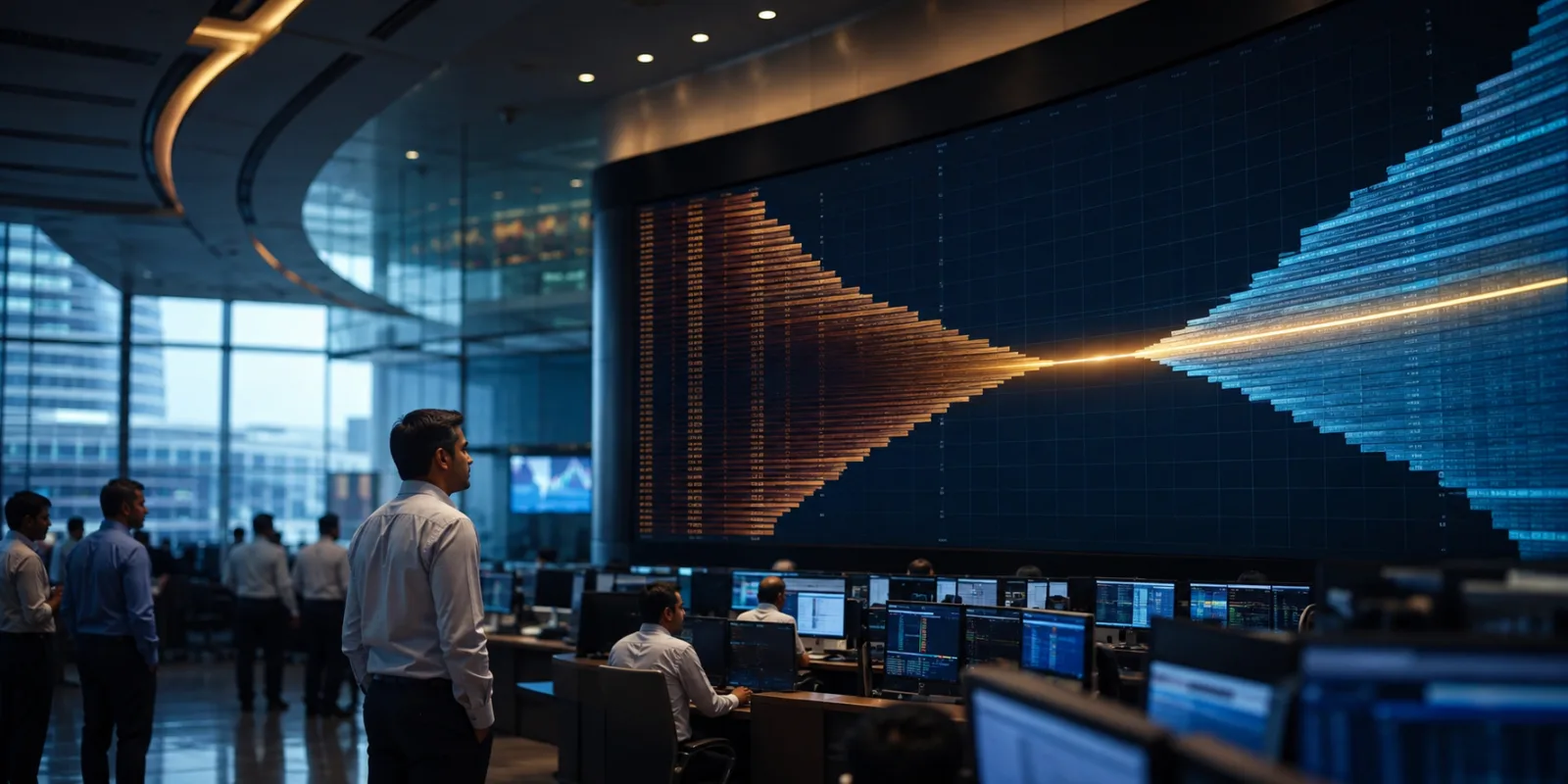
The heart of a call auction is the uncross. As orders accumulate, the exchange constructs cumulative demand and supply curves across every eligible price. Demand rises as price falls; supply rises as price rises. The equilibrium is where the executable quantity (the minimum of cumulative buy and cumulative sell interest at each price) peaks. Above that price there are more sellers than buyers; below it, the reverse.
Two derived quantities matter to traders. The indicative equilibrium price is what the auction would clear at given current orders, and the order imbalance is the residual quantity that cannot be filled at that price. In mature markets these are disseminated during the auction so participants can respond, and firms build short-horizon models that forecast the final print and the sign of the imbalance. Because fills occur at one price, the game is not about queue priority but about correctly anticipating where equilibrium lands and supplying or withdrawing liquidity accordingly. India's ±3% band and 3:00 to 3:15 pm VWAP reference are the guardrails inside which that forecasting problem plays out.
Critical analysis#
The theory is sound; the debut was not. Its first week produced sharp end-of-day swings, confusion over official closing levels, unusual derivatives moves and a visible divergence between the Sensex and the Nifty (Outlook Business). On day one, the Nifty 50 traded near 24,573 when continuous trading ended at 3:15 pm but settled at 24,774.30 once the auction cleared, a jump of more than 200 points that reflected genuine price discovery, not a glitch (Trade Brains). The index divergence has a mundane cause: with NSE and BSE running overlapping but not identical closing mechanisms during the transition, benchmarks built on different constituents and processes will not print in lockstep (Outlook Business).
The strengths are real. A single auctioned price is far harder to manipulate than an average vulnerable to a burst of aggressive orders in the closing seconds, and it hands institutions a genuine execution venue at the official mark. The limitations are equally real. Auctions concentrate risk into one moment: thin participation or a stale reference price can produce a clearing price that gaps from the prevailing market, exactly the swings seen in week one. Retail investors, who rarely trade the close, are largely unaffected, but derivatives traders and institutions face the steepest adjustment (Outlook Business). SEBI has shown no inclination to retreat; board member K.V.R. Murty met leading brokerages during the week and characterised the disruption as "teething issues" as liquidity matures (Outlook Business). Whether that confidence proves justified depends on how quickly auction depth builds and how well the ±3% band contains outliers.
This is best read as a structural convergence rather than a cyclical wobble. Closing auctions are the global norm: New York, Nasdaq, London and Euronext have run them for years, and their share of daily volume has climbed steadily with the rise of indexing. India adopting the same architecture is an incremental step for the world but a paradigm shift domestically, ending a two-decade reliance on VWAP closes. It also fits a broader arc of SEBI market-structure activism over the past two years, from tighter futures-and-options rules aimed at curbing retail speculation to this attempt to make the single most-referenced price of the day both cleaner and harder to game. The macro backdrop is comparatively calm: the Reserve Bank held its repo rate at 5.25% on 5 August with a neutral stance (Forbes India), leaving microstructure, not monetary policy, as the story that will reshape trading behaviour.
Key takeaways#
- Since 3 August 2026, the official close for every F&O-eligible Indian stock is set by a single-price auction from 3:15 to 3:35 pm, not by a thirty-minute VWAP.
- The reform is engineered for passive flows: it lets index funds and ETFs execute rebalancing trades at the official mark, cutting tracking error and closing-price manipulation risk.
- SEBI justified it with hard numbers: tracking differences of -3.39 bps on rebalance days versus -0.19 bps otherwise, and end-of-day volatility up to 3.3 times higher on MSCI change days.
- Week one was turbulent: 200-point auction swings in the Nifty, Sensex-Nifty divergence and broker confusion, which the regulator framed as transitional.
- Quant and execution desks face the largest overhaul, as market-on-close and index-arbitrage strategies must be rebuilt around equilibrium pricing and imbalance signals.
Frequently asked questions#
Which stocks are affected? Only Category I stocks (those with active futures and options), including all Nifty 50 and Bank Nifty names. Non-derivative stocks close as before.
What replaces the old VWAP close? A call auction that computes one equilibrium price maximising matched volume; all auction trades fill at that price (Paytm Money).
What is the reference price and price band? The reference is the VWAP of trades from 3:00 to 3:15 pm, and auction orders are limited to ±3% around it (Sahi).
Which order types are allowed? Only limit and market orders. Stop-loss and iceberg orders are excluded, and resting stop-losses on eligible stocks are cancelled (Sahi).
Why did the Nifty jump on day one? Auction-based discovery produced a clearing price above the 3:15 pm level (about 24,774 against roughly 24,573), reflecting genuine end-of-day demand rather than a technical fault (Trade Brains).
Does this help ordinary investors? Retail traders who do not trade the close see little direct effect; the main beneficiaries and the most affected participants are institutions and derivatives traders (Outlook Business).
Is this how other markets work? Yes. The United States, United Kingdom and continental Europe have long used closing auctions, which now handle a large and rising share of daily turnover (Traders Magazine).
This article is for information only and is not investment advice. Figures and market levels are as reported by the cited sources; forward-looking statements about liquidity and volatility are interpretations, not certainties.
References#
- SEBI Closing Auction Session, mechanics and equilibrium pricing: Paytm Money
- Circular basis (16 January 2026) and scope: Share.Market
- NSE product page and category structure: NSE India
- Session timings and windows: Outlook Money
- Reference price, ±3% band, order types: Sahi
- SEBI tracking-error and volatility data: Business Standard
- Passive ownership and closing-auction turnover (peer-reviewed): Journal of Financial Markets via ScienceDirect
- US closing-auction volumes and Russell reconstitution: Traders Magazine
- Euronext MSCI rebalance auction volumes: The TRADE
- First-week performance, divergence and SEBI response: Outlook Business
- Day-one Nifty print and VWAP replacement: Trade Brains
- RBI August 2026 policy (repo held at 5.25%): Forbes India